ForceSight
A hackathon prototype predicting His Majesty's Inspectorate of Constabulary and Fire and Rescue Services (HMICFRS) performance ratings for police forces, from historical Home Office data.
What it does
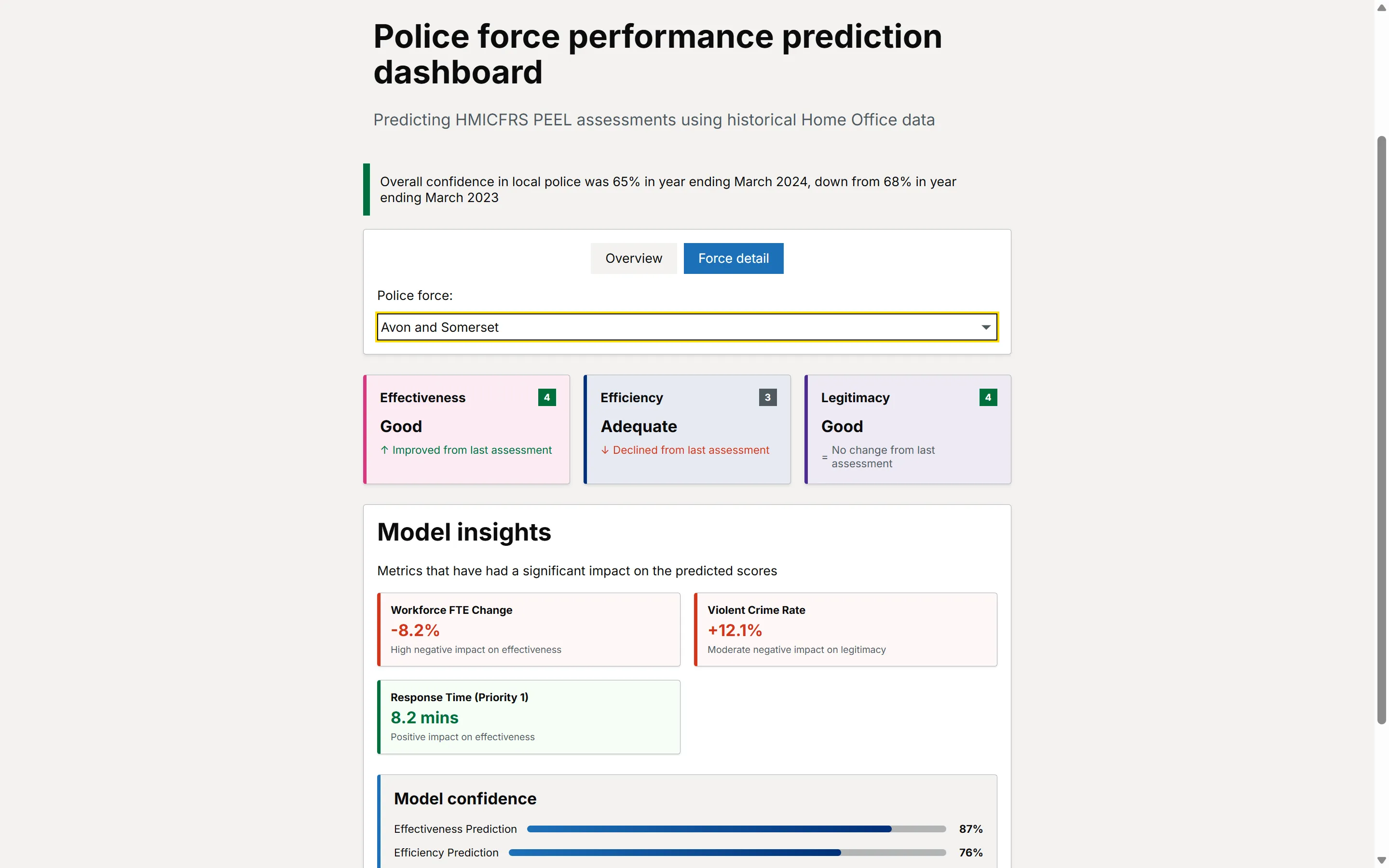
ForceSight predicts how a police force is likely to score in its next HMICFRS inspection—across the PEEL pillar ratings used to judge force performance—using a model trained on historical Home Office data. This allows intervention soone than waiting for the next inspection. A dashboard, styled as a GOV.UK prototype service, lets a user switch between a national overview and a single force’s detail view, surfacing the key factors behind that force’s predicted rating.
How it works
A Random Forest model is trained separately for each of the four PEEL pillars on a cleaned dataset of force-level indicators. A feature-analysis pass over the trained models identifies which factors matter most for each pillar, turning raw model output into something a policy audience can act on. The frontend is a static GOV.UK-styled dashboard that reads the model’s outputs and factor rankings and renders them per force.
The interesting problem
As with all hackathons, the biggest challenge was time constraints. Locating and cleaning relevant open-source data sets for each police force, and normalising them, took significant time. And more fundamentally, trying to generate meaningful insights from around only 360 data training sets proved highly challenging.
Stack and why
A Random Forest was chosen over more opaque models for its built-in feature importances—for a policy-facing prototype, being able to explain why a force scored as predicted mattered as much as the prediction itself. The frontend deliberately mimics the GOV.UK Design System so the prototype reads as a plausible real government service rather than a generic hackathon demo.
What I would do differently
The Random Forest model, in the time available, did not produce statistically significant predictions. The data set needs better feature engineering with actual inspectors and police forces, to prevent overfitting.
Stack
- Python (pandas, scikit-learn)
- Data cleaning, feature engineering, and Random Forest model training across the four PEEL pillars
- HTML / CSS / JavaScript
- Interactive dashboard frontend, styled against the GOV.UK Design System
- GOV.UK Design System
- Header, phase banner, forms and typography—a prototype-service look consistent with real GOV.UK products
- Repository—private repository